















































Shanti Juniors Franchise ROI, Worked Through: An Illustrative 60-Child Centre in a Growing City
A worked, illustrative five-year ROI model for a 60-child Shanti Juniors-style preschool centre in a growing city, showing ramp-up, break-even, payback and the assumptions that move the result.

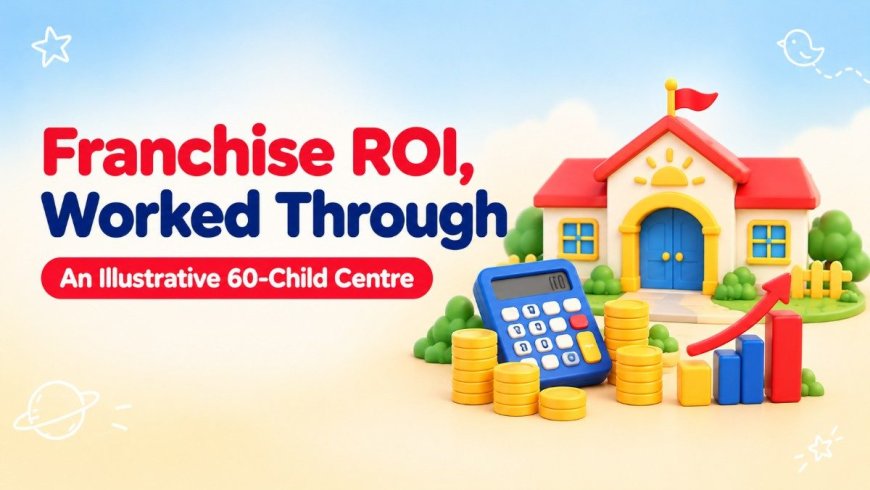
The return on a Shanti Juniors franchise, like any preschool franchise, depends on three local numbers: how many children enrol, what fee your area supports, and what your rent and salaries cost. This article builds an illustrative five-year model for a centre in a growing city that grows to about 60 to 65 children. In this model, the centre makes a loss in year one, reaches monthly break-even during year two, earns operating margins of around 20 to 26 percent from year three, and recovers its setup investment in about year five. Every figure is an assumption for illustration, not a figure supplied by the brand, and you should rebuild the model with the written quote you receive.
Why build a worked example instead of quoting an ROI percentage?
Because a single ROI percentage hides the assumptions that produce it, while a worked model shows exactly which numbers you need to verify for your own site.
Shanti Juniors quotes a franchise investment of 10-15+ lakhs and a space of 1500+ sq ft, but no responsible franchisor can promise a return. What an investor can do is understand the structure of preschool economics and test it against real local inputs. The brand's notes on maximising returns from a preschool franchise cover the levers, and this model shows how they interact over time.
The brand context is useful background. Shanti Juniors reports around 16 years of operation, 350 plus centres across 74 plus cities and 500 plus franchise partners, with a focus on first-time owners and growing residential markets. Those are the conditions this example assumes.
What assumptions does the model use?
A 12 lakh rupee setup, fees starting at 3,500 rupees a month over 11 months, enrolment rising from 25 to 65 children, and a placeholder brand fee of 10 percent of collection.
|
Assumption |
Value used |
Comment |
|
Setup investment |
12 lakh rupees |
Within Shanti Juniors' quoted range of 10-15+ lakhs |
|
Monthly fee |
3,500 rupees, rising to 4,100 by year five |
Typical of a mid-priced centre outside premium metro areas, verify locally |
|
Fee months per year |
11 |
Allows for vacations and collection gaps |
|
Annual charges |
5,000 rupees per child |
Admission or annual fees, varies widely |
|
Rent |
35,000 rupees a month, rising about 5 percent a year |
Ground floor in a residential catchment |
|
Staff cost |
60,000 a month in year one, rising to 98,000 |
Teachers, helpers and coordinator as enrolment grows |
|
Brand fee or royalty |
10 percent of collection, placeholder only |
Replace with the actual figure in your written quote |
|
Consumables |
300 rupees per child per month |
Materials, snacks, stationery |
|
Marketing |
1.5 lakh in year one, 96,000 a year afterwards |
Launch spending is higher |
The royalty figure is a placeholder chosen for illustration. It is not Shanti Juniors' actual fee structure. Request the brand's current fee sheet and replace this line before relying on any output.
What does the five-year picture look like?
A loss in year one, roughly break-even in year two, healthy margins from year three, and cumulative recovery of the setup investment during year five.
|
Year |
Average children |
Revenue (rupees) |
Costs (rupees) |
Operating result (rupees) |
Margin |
Cumulative position after setup |
|
1 |
25 |
10.88 lakh |
15.65 lakh |
minus 4.78 lakh |
minus 44% |
minus 16.78 lakh |
|
2 |
45 |
19.58 lakh |
19.25 lakh |
plus 0.32 lakh |
2% |
minus 16.46 lakh |
|
3 |
60 |
27.42 lakh |
21.95 lakh |
plus 5.47 lakh |
20% |
minus 10.99 lakh |
|
4 |
65 |
31.14 lakh |
23.32 lakh |
plus 7.82 lakh |
25% |
minus 3.17 lakh |
|
5 |
65 |
32.57 lakh |
24.06 lakh |
plus 8.50 lakh |
26% |
plus 5.33 lakh |
Two different milestones are worth separating. Monthly operating break-even, when fee collection covers the month's costs, arrives during year two in this model, which matches the sector benchmark of 18 to 30 months. Full capital payback, when the centre has earned back the setup money and the year-one loss, arrives later, around year five. Many projections blur these two, so ask which one any figure refers to.
Which assumptions move the result the most?
Occupancy and fee level move the result far more than any other input, which is why location and parent trust matter more than small differences in franchise fee.
The sensitivity table below shows the year-three operating result at different combinations of enrolment and monthly fee, holding other assumptions constant.
|
Children enrolled |
Fee 3,200 |
Fee 3,700 |
Fee 4,200 |
|
45 |
minus 2.44 lakh |
minus 0.21 lakh |
plus 2.02 lakh |
|
55 |
plus 0.85 lakh |
plus 3.57 lakh |
plus 6.30 lakh |
|
60 |
plus 2.50 lakh |
plus 5.47 lakh |
plus 8.44 lakh |
|
70 |
plus 5.78 lakh |
plus 9.25 lakh |
plus 12.71 lakh |
The pattern is clear. A centre that settles at 45 children struggles at almost any fee in this model. A centre that reaches 60 or 70 children performs well across most fee levels. Getting from 45 to 60 children is mainly a question of catchment, reputation and retention across nursery, junior KG and senior KG.
How can an owner improve on this model?
By adding daycare hours, improving retention across the three preschool years, controlling rent at the start, and filling the first batch faster through strong pre-launch marketing.
-
An afternoon daycare wing uses the same rent and building, adding revenue with limited extra fixed cost.
-
Retention matters because each child can stay three years or more, so losing children between classes is expensive.
-
Lower rent in year one reduces the early loss and shortens capital payback.
-
A strong launch, timed to the admission season, can lift year-one enrolment well above 25.
Shanti Juniors' guidance on growth strategies for franchise owners and on ongoing costs is useful when adjusting these levers.
How should you use this model before signing?
Replace every assumption with figures from your written quote, your rent offer and nearby fee levels, then check the result at lower occupancy before deciding.
Ask the brand for its current franchise fee, recurring fee structure, area norms and what is included in setup. Ask nearby centres what they charge. Get a rent quote for a specific building. Then rebuild this table and look hard at the 45-child line. If your plan only works at full occupancy, the setup is too expensive or the site too weak. You can request current figures through the Shanti Juniors franchise page.
Frequently asked questions
What is the Shanti Juniors franchise cost?
Shanti Juniors quotes a franchise investment of 10-15+ lakhs and a space of 1500+ sq ft. Rent, salaries and working capital are separate, so request a current written quote for your city.
What ROI can a Shanti Juniors franchise give?
It depends on local occupancy, fees and rent. In this illustrative model, the centre reaches about 20 to 26 percent operating margins from year three and recovers its setup cost around year five.
How long does it take to break even?
Monthly operating break-even typically arrives in 18 to 30 months across the sector. Recovering the full setup investment usually takes longer.
Is the 10 percent royalty in this model the brand's real fee?
No. It is a placeholder for illustration only. Use the figure in the brand's written quote.
What is the biggest driver of profitability?
Occupancy. A centre that reaches 60 or more children is far more resilient than one that settles at 45, whatever the fee level.
Author Bio
Written by an independent education-sector analyst who studies India's early-education franchise market, including brands such as EuroKids, Kidzee, Little Millennium and Shanti Juniors.
What's Your Reaction?