





































Bridging Continents and Futures: Inside the UN Geneva Dialogue on Sustainable Development 2026
On December 18, 2025, the historic halls of the United Nations Office in Geneva became the stage for an ambitious and multidimensional global dialogue—one that sought not only to connect continents, but to redefine the very mechanisms of cooperation in an increasingly complex world. The conference, titled “Non-Governmental Organizations of Europe and Asia: Dialogue for […] The post Bridging Continents and Futures: Inside the UN Geneva Dialogue on Sustainable Development 2026 first appeared on HindustanMetro.com.

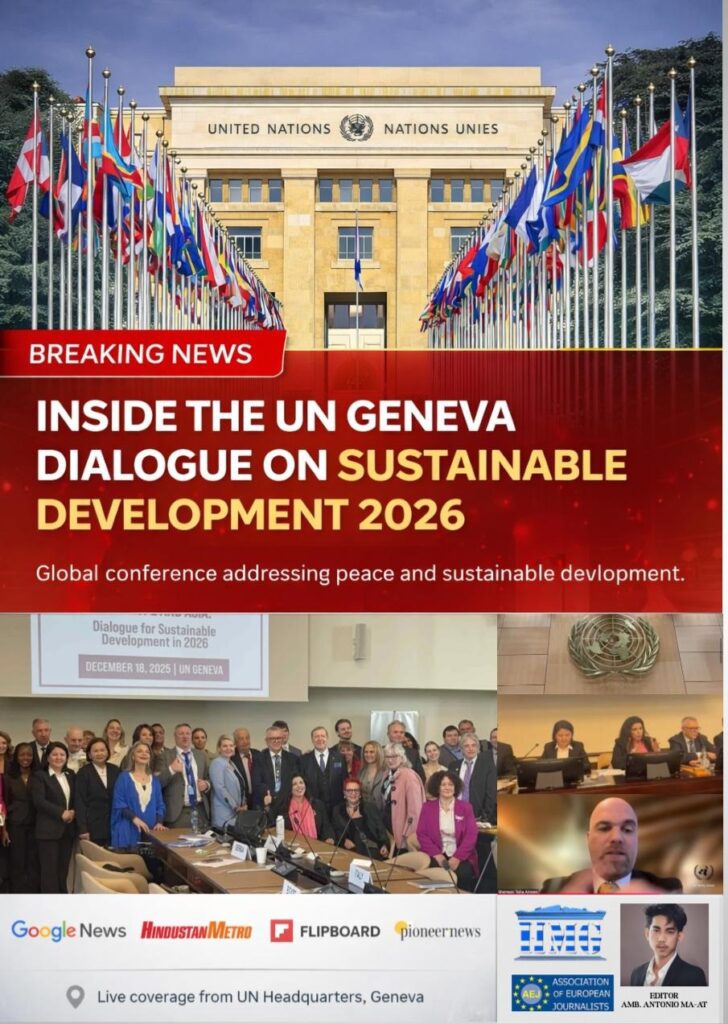
On December 18, 2025, the historic halls of the United Nations Office in Geneva became the stage for an ambitious and multidimensional global dialogue—one that sought not only to connect continents, but to redefine the very mechanisms of cooperation in an increasingly complex world. The conference, titled “Non-Governmental Organizations of Europe and Asia: Dialogue for Sustainable Development in 2026,” convened an extraordinary coalition of voices from 118 countries, each bringing with them a distinct perspective on peace, innovation, and the future of global development.
At its core, the gathering was not merely a conference, but a convergence of diplomacy, civil society, technology, and philosophical inquiry. It stood as a testament to the evolving role of non-governmental organizations (NGOs) in shaping international discourse—no longer confined to advocacy alone, but now actively participating in the architecture of global solutions.
⸻
A Global Platform for Urgent Conversations
The conference addressed some of the most pressing challenges facing Europe and Asia, regions whose political, economic, and cultural trajectories remain deeply intertwined. Discussions centered on peacebuilding, sustainable development, and the shifting political and military landscape across both continents.
In a time marked by geopolitical uncertainty and rapid technological transformation, the forum provided a rare opportunity for open dialogue. Delegates engaged in discussions that balanced realism with aspiration—acknowledging current tensions while envisioning pathways toward stability and cooperation.
Yet what distinguished this conference from traditional diplomatic gatherings was its inclusivity. By bringing together NGO leaders, policymakers, journalists, scholars, and innovators, the event fostered a multidimensional exchange of ideas—one that transcended institutional boundaries.
⸻
The Emergence of Business Diplomacy
One of the most anticipated segments of the conference was the thematic session titled “Trump–Musk–Karić Business Diplomacy and UN Sustainable Development Goals in 2026.” This section underscored a growing recognition: that the private sector and influential global figures are increasingly central to diplomatic processes.
The concept of business diplomacy—where economic influence intersects with geopolitical strategy—was explored through the lens of leadership, innovation, and responsibility. Participants examined how figures such as former U.S. President Donald Trump, technology visionary Elon Musk, and Serbian philanthropist Bogolyub Karić represent different dimensions of global influence.
What made this segment particularly compelling was its interactive nature. Through the conference’s live broadcast infrastructure, participants were given the opportunity to pose direct questions—an unusual and symbolic gesture that reflected a shift toward more accessible and participatory global dialogue.
This approach suggested a future where diplomacy is no longer confined to closed-door negotiations, but instead becomes a more transparent and inclusive process, shaped by a broader spectrum of stakeholders.
⸻
Artificial Intelligence Enters the Diplomatic Arena
Perhaps the most forward-looking aspect of the conference was the integration of artificial intelligence into the dialogue itself. Described as the participation of “the best artificial intelligences,” this initiative marked a conceptual leap in how global discussions are conducted.
Rather than serving merely as tools, AI systems were positioned as contributors—capable of offering insights, analyzing data, and even expressing perspectives on key issues. This development raises profound questions about the future of decision-making: Can artificial intelligence augment human diplomacy? And if so, how should its role be defined and governed?
The inclusion of AI in such a high-level forum reflects a growing recognition that technology is not just shaping the world—it is becoming an active participant in its governance.
⸻
Resolutions for a Changing World
The conference concluded with the adoption of several forward-looking resolutions, each reflecting the intersection of tradition, innovation, and global responsibility.
Among these was the Resolution on the International Nikola Tesla Memorial Day, a symbolic acknowledgment of the enduring legacy of scientific innovation. By honoring Tesla, the conference emphasized the importance of creativity and discovery in addressing modern challenges.
Equally significant was the Resolution on the Academy of Artificial Intelligence BK Tesla, which points toward the institutionalization of AI research and education within an ethical and globally coordinated framework.
In an era increasingly defined by information warfare and digital misinformation, the Resolution on Countering Fakes Using Artificial Intelligence in Journalism stood out as particularly urgent. It highlighted the need for technological solutions to safeguard truth and credibility in media.
Finally, the Resolution on the Intercultural Adaptation of Migrants Using Artificial Intelligence addressed one of the most complex social issues of our time. By proposing the use of AI to facilitate integration, the conference acknowledged both the challenges and opportunities presented by global migration.
Together, these resolutions reflect a broader vision—one that seeks to harmonize technological advancement with human values.
⸻
The Architects Behind the Dialogue
The conference was initiated and sponsored by the Karic Brothers Foundation, under the leadership of Serbian businessman and philanthropist Bogolyub Karić. As President of the Nikola Tesla International Committee within the World Philosophical Forum, Karić’s influence was evident in the conference’s emphasis on innovation, philosophy, and cross-cultural dialogue.
Supporting the initiative were organizations with consultative status within the United Nations Economic and Social Council (ECOSOC), including the International Association of Peace Foundations (Serbia) and the International Institute of Middle Eastern and Balkan Studies (Slovenia).
The event’s panels and roundtable discussions were moderated by representatives from a diverse array of partner organizations, including the World Philosophical Forum, the European Institute of Communications, the Association of European Journalists, and the Ecumenical Delphic Union. This collaborative framework ensured that the conference was not dominated by a single perspective, but rather enriched by a plurality of voices.
⸻
A Truly Global Audience
In keeping with its inclusive ethos, the conference was broadcast worldwide via Zoom and YouTube, allowing audiences far beyond Geneva to participate in the dialogue. This digital accessibility reflects a broader shift in how international events are conducted—where physical presence is no longer a prerequisite for meaningful engagement.
For many viewers, particularly those from regions underrepresented in traditional diplomatic forums, the livestream provided a rare window into high-level discussions. It also reinforced the idea that global governance is not the exclusive domain of states, but a shared responsibility that extends to civil society and individuals alike.
⸻
Redefining the Role of NGOs
At its heart, the conference was a celebration of the evolving role of non-governmental organizations. Once seen primarily as advocates or watchdogs, NGOs are now emerging as key players in shaping policy, fostering dialogue, and driving innovation.
By convening such a diverse and influential assembly, the event demonstrated that NGOs can serve as bridges—connecting governments, businesses, and communities in ways that traditional institutions often cannot.
This transformation is particularly significant in the context of sustainable development. As the world approaches critical milestones in the implementation of the UN Sustainable Development Goals, the need for collaborative and cross-sectoral approaches has never been greater.
⸻
A Vision for 2026 and Beyond
The Geneva conference was not an endpoint, but a starting point—a moment of reflection and projection as the global community looks toward 2026 and beyond. It highlighted both the challenges that lie ahead and the innovative strategies required to address them.
From the integration of artificial intelligence into governance, to the emergence of business diplomacy, to the reaffirmation of human values in an increasingly technological world, the conference offered a glimpse into the future of international cooperation.
It also underscored a fundamental truth: that the path toward sustainable development is not linear, nor is it confined to any single region or sector. It is a collective journey—one that demands dialogue, adaptability, and a willingness to embrace new ideas.
⸻
Conclusion: A New Chapter in Global Dialogue
In many ways, the “Non-Governmental Organizations of Europe and Asia: Dialogue for Sustainable Development in 2026” conference represents a new chapter in global dialogue. It reflects a world in transition—where traditional boundaries are dissolving, and new forms of collaboration are emerging.
By bringing together diverse voices, embracing technological innovation, and fostering open dialogue, the event set a precedent for what international cooperation can look like in the 21st century.
As the world continues to navigate uncertainty and transformation, such initiatives serve as vital reminders that progress is possible—not through isolation, but through connection.
And in Geneva, on that December day, the world did not merely gather to talk. It gathered to imagine, to question, and to begin shaping the future together.
written by: Antonio Ma-at
The post Bridging Continents and Futures: Inside the UN Geneva Dialogue on Sustainable Development 2026 first appeared on HindustanMetro.com.
What's Your Reaction?